Play & Development areas

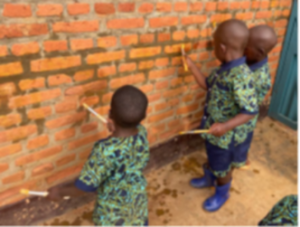
When children play  you see them being actively engaged in enjoyable activities which they initiate by themselves. Children play not because they want to achieve a goal, but rather because they enjoy doing so. During play you often see children imitate situations they have seen or gone through, this can also be called ‘role-play’.  

Though it is important that children direct and initiate their own play. Play can be stimulated and guided by the caregiver or teacher; by introducing the theme or topic the children can play about, providing the materials the children can play with, by joining the role-play (e.g. the teacher can order a meal in the childrens’ restaurant) and by asking questions. 


Why play? 
  • Play is the natural way young children learn. They understand the world by trying things out.  
  • Play is children’s way of communication. 
  • Play gives children space to explore, make mistakes, and learn from them. 
  • Play connects joy with growth across all areas of development. 
  • Play prepares children for school and for life. 
  • Play improves child well-being. 
  • Playing with others nurtures empathy and resilience. 
  • Play stimulates children in all their developmental domains: physical, social-emotional, cognitive, language, numeracy, cultural & moral.
Play can also be ‘healing’: 
  • Play can help to process experiences and cope with changes (role play, fantasy play, drawing, movement). 
  • Play can help to manage and regulate emotions. 
  • Play can improve problem solving and coping skills. 
  • Play increases positive feelings, feelings of agency and hope. 
  • Play offers relaxation. 
  • Play can strengthen relations. 

Cognitive Development 

The cognitive domain, also referred to as the intellectual domain, refers to the intellectual growth of a child, their brain development, and their capacity to learn and understand the world around them.  

Cognitive development includes: the ability to think and reason, learning, problem solving, emergent numeracy, early mathematics, sciences grounded in observation, exploration, and discovery. It also involves how children think, explore and how they process the world around them, remember and use information. 

Children’s cognitive development can be enriched through stories, songs, riddles, interaction with others and through observation in the environment.  During play, children apply the knowledge they acquired and so deepen their understanding of what they have learned. So when they have seen parents cook in the kitchen, children act this out through role-play. This way they can for example deepen their understanding of the use of the utensils such as saucepan, spoon, plate etc. They learn and understand more by doing and exploring it by themselves. 

Through play children can deepen their understanding about;  

  • different roles in the society; family members, the doctor, shopkeeper etc. 
  • social and economical events; going to the church, going to the market, use means of transport, etc. 
  • use of different tools; utensils, hygiene materials, different types of clothes etc. 

Language Development 

Language development is a child’s ability to both understand what is being communicated to them and to express themselves verbally. Language development is depending on exposure and cultural practices. 

Language  development starts in infancy with sounds and gestures and eventually develops into words and sentences as children get older. Developing language skills is the first step in literacy as it forms the foundations for early reading and writing. By speaking, listening, reading, and writing, children expand their vocabulary and learn to communicate effectively. This not only helps them acquire knowledge but also to build relationships and articulate emotions. 

Elements of language development in early childhood (in the age of 3 – 7 years) are; 

  • Listening (Language understanding) 
  • Speaking 
  • New vocabulary 
  • Pre-Reading Skills  
  • Pre-Writing Skills 

 During play, childrens’ language skills can be stimulated through; 

  • Introduction of the topic children play about through story-telling 
  • Interaction with the children; ask open questions preferably by joining in the play. 
  • Name the objects the children use during their play and mention the actions of the children. 
  • Sing songs together, preferably with movements. 

Pre-reading 

  • Let children hold picture books 
  • Talking walls with letters, exposure to books/ newspapers 
  • Read stories from a book 
  • Introduce letter shapes and letter sounds 

Recognition of lettershapes 

  • Games such as memory game, match cards and match shapes (visual discrimination) 
  • Place name cards on chairs; recognition of own name 

(picture: find the 10 differences) 

Recognition of lettersounds 

  • Start with letter-sounds; E.g. which words start with letter ‘m’?  
  • Sing songs about the sound 
  • What is the last letter of ‘mat’?  
  • Rhymes (picture right: match the rhyming words)  

Numeracy Development 

In a playful way, with guidance from adults, young children can learn mathematical concepts.  

Concepts related to measurement such as; more and less, big and small, long and short, adding and removing. Also think about the concept of time and discuss what can be done in an hour and what in a minute. 

Young children can orient themselves on geometry, by naming and differentiating shapes 

When it comes to numbers, children in the age of 3 have heard about numbers and can sometimes show with their fingers how old they are. They can say whether they are the first or the last.  
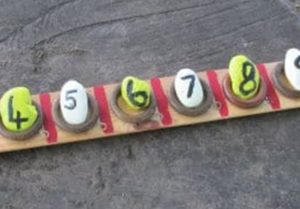
Around the age of 4, children start citing/singing the number line. First this is done without knowing what it represents. The next stage is that children point at objects when counting, first by pointing randomly but when guidance is given the child can point synchronic at the object he/she is counting. Next the child can pick the correct number of items when a number is said a loud. Lastly, the child can represent the correct number when the children see the number shape. 

To further practice the number concepts, activities can be done related to grouping. For example, children can make groups of 5 blocks or children can run on the playground and when the teacher clapps in his/her hands she shouts a number and children group themselves according to that number. 

As part of this grouping, children need to practice to split the numbers. This can be done by a game: How many are gone? Show that you have for example 5 objects and tell the child to close his/her eyes. Hide 3 objects and ask the child to open his/her eyes, then ask: How many are gone? Practice this with different quantities. 

Young children orient themselves on the number line; they can place the number shapes in correct order. They can place the correct number of objects next to each number shape and can indicate which number is more or less. Lastly, children are able to see which number shape is missing when removing a number shape from the numberline. 

During play children can orient themselves on numeracy by; 

  • Mentioning the size, weight or shapes of objects they play with 
  • Mentioning and counting how many objects they have, for example how many fish they bought from the market 
  • Identifying who has more or less, for example when distributing food on the plate during their role-play. 

The caregiver/teacher can stimulate this development by asking questions such as; how many fish did you buy? Are you having enough for everyone? Who has more? 

Physical Development 

Physical skills form the foundation for daily actions, play and learning. Children naturally use their bodies to make sense of the world around them.  

Gross motor skills are the movements with your whole body, such as rolling, crawling, standing, walking, jumping, climbing and cycling. These skills often develop first and form the basis for mobility, balance, and a good sense of one’s body in space. 

Fine motor skills refer to the control of the hands and fingers. For example, picking up small items, drawing, folding paper, practicing pencil grip to be able to draw and later to write.  Before children can write, fine motor skills – tiny movements made with hands and fingers – need to be practiced. Young children in the age of 3 -4 years old are physically not yet ready to hold a pencil and start writing small letters and numbers. Their muscles first need to grow and muscle coordination needs to be practiced through other activities.  After practicing the fine motor skills of children through various activities, including pre-writing activities, the children can start writing on lines in the age of 6 years old.  

Activities to stimulate fine motor skills: clay-moulding, drawing, tearing, tracing, folding, placing, puzzles.  

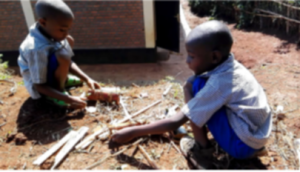
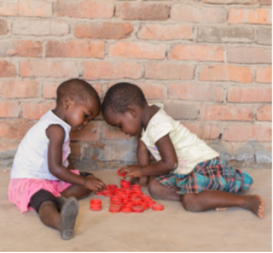
During play, children make movements with their whole body. They practice gross motor skills when they making movements while imitating as if they are digging in the garden, washing clothes, brooming the house etc. The children practice fine motor skills during play when they use smaller items, like a spoon to cook, money made out of paper, small sticks to play as if they are making a fire, driving a small car or playing with small dolls or bottle-tops. 

Social Emotional Development 

The way you feel emotionally affects the way you can participate in social activities. If you are feeling fearful, you may not respond to a teacher or initiate an activity. And when others are responding negatively to you, you may be emotionally affected.

In the early years children need to be guided on how to manage own emotions, how to relate to others, how to behave according to the social rules and how to solve problems together. When this guidance has gone well, a good foundation is laid which enables the child in future to better manage everyday social interactions later in life, find it easier to develop secure relationships and perform better in school. These children are less likely to be involved in crimes and violence as they learned to be empathetic to others and solve problems in a peaceful way. 

Social and emotional development includes: the development of self-awareness, self-confidence, understanding emotions & emotion regulation, social skills, and how to form and sustain positive relationships.  

As presented in the figure below from ‘Little Seeds HK’ children move from being ego-centric (only focussed on themselves) towards making friends, being aware of the feelings of others and showing empathy. When a child is 3-4 years it starts to recognise its own feelings, but finds it still hard to control them. When moving to 5 years old the child is able to manage its impulses better and around the age of 6 years old the child is able to be sensitive towards the feelings of others and understands better the consequences of its actions.  

Play offers many opportunities to practice social and emotional skills through: 

  • By playing with diverse peers, children learn to value different perspectives, understand each other’s feelings, and show respect for differences. 
  • Through play children express how he/she is feeling for example when a child ‘acts like a sad child’. 
  • Guided play and support in the interaction with peers; The teacher can for example say ‘I can see you are angry, what can help calm you down’?’ 
  • Play and problem-solving activities can promote empathy and social skills.