
Classroom management

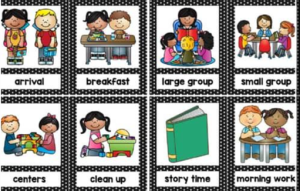
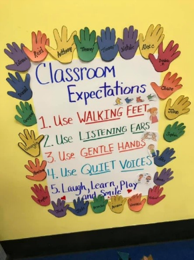
The classroom management is the way the caregiver/teacher is organizing the childrens’ movements and activities. It shows how children are taken care of, how they are stimulated to develop and what the teacher intends the children to learn. Strategies used are setting clear rules, routines and positive disciplining. 

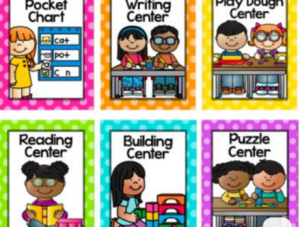
A learning corner is a physical area (a space in the classroom or outside) designed to provide an appropriate play space, including playful learning materials, to stimulate learning and development in specific learning and developmental areas. 

Element of classroom arrangement  Purpose 
Display of children’s work  Creates an attractive environment and benefit children’s self-esteem (I made something beautiful!) 
‘Talking walls’  Encourages children’s self-discovery, independent learning 
Material arrangement 


Children can pick materials by themselves and learn where and how to place them back 
Space for physical activities/creating a circle 


Encourages play, physical activities and ‘circle conversations/dialogues’. 
 

Tables/ corners for children to work and play in groups 

Stimulates groupwork/play, social-interaction and learning from each other 
 

Space 

Ensure there is enough space for the teacher to walk around to guide the children 
  • Children learn best when they are involved in hands-on activities and play. 
  • Learning corners provide opportunities for children to choose, play, experiment and explore materials. 
  • Learning corners promote socialization in learning. 
  • Learning corners provide an environment that conveys a joy of learning. 

Working in learning corners encourages active and participatory learning, allowing children to discover the world around them through play, interaction and exploration.  

In a playful way all developmental domains are promoted, as children explore and experiment at their own pace. Learning corners allow children to use up excess energy and take risk without fear of failure. In addition, learning corners relate to the individual needs and interests of each child, which facilitates more meaningful and enjoyable learning. Furthermore, learning corners allow children to develop social skills, such as teamwork and communication, while encouraging autonomous decision-making.  

Each learning corner should be designed to encourage a specific type of activity or play. Four basic learning corners are:  

  • Roleplay corner 
  • Arts and creativity corner 
  • Numeracy corner 
  • Literacy corner 

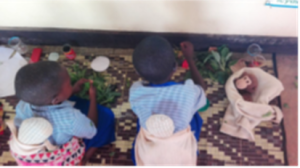
This corner provides a space for children to act out role-play. Their play is stimulated by the provision of various materials. The materials and set-up of this corner can be linked to a theme. You can use materials found at home, so the children can act out as if they are living at home, using (pretend) food, utensils, puppets and dress up materials (clothes, fabric, hats, shoes etc.). Or the children can act as if they go to the market or shop, then you can provide empty tins and paper-money and arrange the materials in such a way that it looks like a shop. 


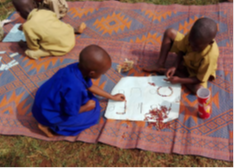
Art helps children to express themselves, to regulate and to develop creativity. It is a good way for children to develop fine motor skills and improve their hand-eye coordination. Working with materials teaches them about colors, shapes and textures. 

The teacher/caregiver can guide the children’s activities by providing a selection of materials each time and inspiring them to develop art works related to the theme.  

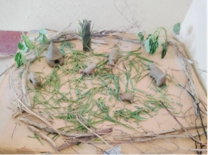
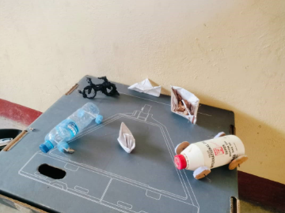
Examples are modeling with clay, making something out of empty tins, drawing pictures, decorating art works. 

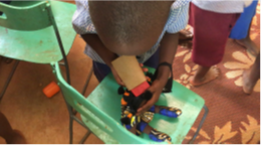
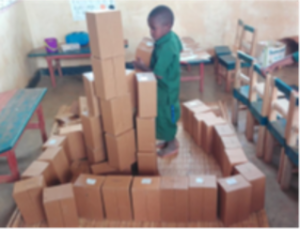
In the numeracy corner children learn to understand beginning math concepts and develop foundational math skills beyond just counting, such as pattern recognition, measurement, spatial awareness, and problem-solving. In this corner children can play games with dices and number cards. The children can also play with blocks of different sizes and shapes, so they can make their own constructions using measurement and balancing. 

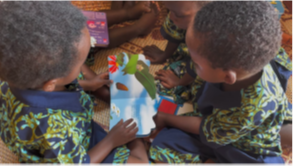
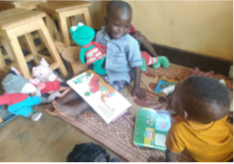
This corner is meant to promote pre-reading skills. Although children in ECE are not able to read letters, the book corner can help them to get familiar with books, to look, interpret and talk about the story together. They develop vocabulary and communication skills.  

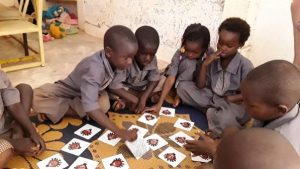
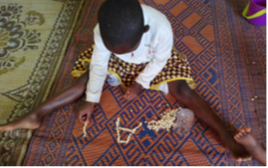
Besides, children can orient themselves on differences between shapes while playing games like memory or domino game. They can also make lettershapes from different materials like bottle tops or seeds.